Insurance shopping rates are at historic highs. In 2025, J.D. Power found that 57% of auto insurance customers actively shopped for a new policy—the highest rate in the 19-year history of the study. Home and life carriers are seeing the same pressure on their funnels.
For carriers writing personal lines at scale, more shopping means more quotes. More quotes mean more data pulled on applicants who may never buy a policy. And under the current pricing model, every one of those pulls costs the same whether the applicant binds or not.
This is the structural problem the industry hasn’t solved. Why? Because the dominant data vendors who have built their business on per-transaction pricing have no incentive to change it.
Why MVR costs keep rising even as carriers try to cut back
State MVR pass-through fees vary widely, with some states running into double digits per record. The carriers who pull back make it more expensive for the carriers who don’t.
At the same time, most carrier contracts with the dominant incumbent are negotiated individually and confidentially. Two carriers with identical books can pay different prices for the same data without ever knowing it. There’s no market transparency, no competitive pressure on pricing, and no model that rewards efficient use of the funnel.
The result is that underwriting data is one of the largest recurring line items for carriers writing personal lines at scale. It keeps growing, whether it results in policies or just more quotes. This is the dynamic we unpacked with carrier leaders at AIRNC 2026.
The applicant risk gap makes it worse
The cost problem is compounded by the data problem. Most pre-bind screening relies on the national criminal database, which misses a meaningful share of records—the ones that sit only at the local county courthouse level. Vendors who pull only from national databases miss them entirely.
This means carriers are paying full price for a partial picture. For example, a carrier pulling an MVR on an applicant who has a fraud conviction in another state that doesn’t appear in the national database is making an underwriting decision on incomplete information.
For home carriers, the gap is even larger. Most don’t screen applicants for criminal history at all. Arson convictions, property crime records, and prior fraud don’t show up in claims history or credit scores. They’re invisible in the standard underwriting stack.
When you only pay on bound policies, early screening becomes free
The fix is straightforward. A carrier pays for a check only when the applicant converts to a bound policy. If they don’t bind, the check costs nothing. We covered the data coverage gap that compounds this problem and why most carriers are already using Checkr Trust data without knowing it in a companion post.
This removes the disincentive to screen early. Right now, carriers delay screening to avoid paying for checks on applicants who drop off. With per-closed-policy pricing, that tradeoff disappears. Carriers can run checks earlier in the funnel. They can catch fraud, identity issues, and behavioral risk before investing further in the applicant. And they don’t have to worry about the cost of everyone who walks away.
For auto carriers, with shopping rates at a record 57% in 2025, this means running smarter checks before ordering an MVR.
For life carriers, where application activity hit a Q1 2026 record, it means criminal and driving history checks happen earlier, before the carrier has invested further in the applicant.
For home carriers, where quarterly shopping rates now run 6% to 7% of policyholders, it means criminal data checks become affordable to run at scale, even on a quote pool where most applicants never bind.
The industry has lived with per-transaction pricing for so long that it can feel like a given. It isn’t. It’s a choice made by a few dominant vendors, and carriers don’t have to accept it.
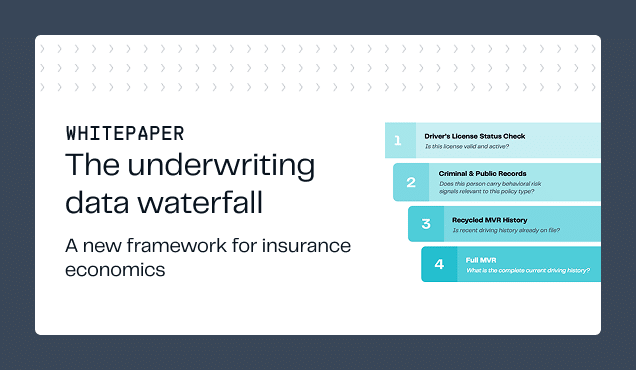
That’s why Checkr Trust’s insurance pre-screen MVR was built. Identity and criminal checks are priced per bound policy and designed to run before the MVR cost ever enters the funnel.
Ready to stop paying for applicants who never convert?
Our underwriting data waterfall brief lays out a complete framework for restructuring pre-bind data spend across auto, home, and life.
Download it to see how the math changes across your current book.