If you’re buying pre-bind criminal data for insurance today, there’s a good chance it originates with Checkr Trust. Legacy data providers and national aggregators license our data, package it, and resell it as part of their commercial datasets. This data pipeline has long been the status quo, but it comes with non-trivial trade-offs: data latency, coverage gaps, pricing friction.
Which is why we’re giving carriers direct access to source data.
It’s the same underlying data with better terms: fresher records, broader coverage, and a pricing model that aligns with how carriers generate revenue.
Here’s what this means in practice.
The criminal records missing from your insurance data stack
National criminal databases capture most criminal records for insurance carriers, but not all. The ones they miss typically sit at the local county courthouse level: local court filings, municipal records, and arrest data that hasn’t reached state or federal sources. Additionally, many counties don’t digitize their records, and some that are online redact key fields. Accessing them often requires physically sending someone to the courthouse. For datasets built on national aggregation, this layer simply doesn’t exist.
We’ve long been a trusted source for national criminal data, but we haven’t made all our data, including our county-level historical records, available to resellers. We’re now opening up that access, directly to carriers.
Checkr Trust reaches these records through direct court integrations, thousands of proprietary scrapers built for counties that are online but not standardized, and an in-house fulfillment team for jurisdictions that still require in-person retrieval. As one of the largest employment background check providers in the U.S., Checkr has spent over a decade building direct relationships with courthouses across the country. That same infrastructure now delivers pre-bind criminal data for insurance underwriting
Another major advantage of doing direct to source is the freshness of the data. County filings can take months to surface in national aggregator databases, and some never make it at all. The delay is compounded by how resellers deliver data – bulk file refreshes that can be up to 30 days old by the time they reach your system. Pulling from courthouses directly closes that lag, meaning carriers access records in real-time.

How criminal data gaps affect each insurance line
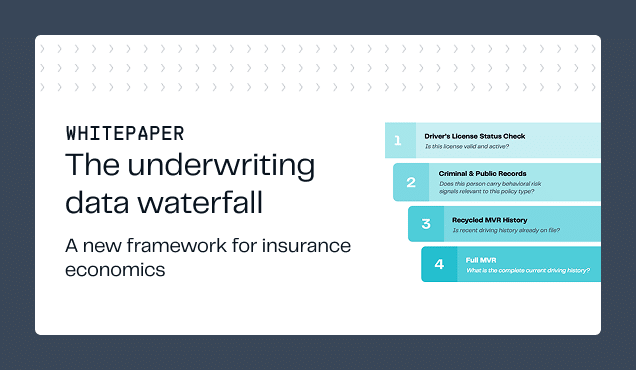
For auto carriers, the county-level layer shows up most clearly in driving-related offense records. Traffic violations, DUI filings, and reckless driving charges that haven’t yet reached the national database are exactly the records that should inform an MVR ordering decision. Surfacing them before pulling a full MVR means the expensive check runs on a smaller, more qualified population.
For life carriers, applicants self-attest their criminal and driving history, and most carriers don’t have the data to verify those responses. Automated access to county-level court records turns self-attestation into an underwriting signal carriers can act on, instead of a risk they have to accept.
For home carriers, the county-level layer is where arson convictions, property crime records, and local fraud filings live. Property data, credit scores, and claims history don’t surface this information. For most home carriers, this data hasn’t been accessible at all.
A pricing model built around how carriers make money
Our pay-per-bind model is first-to-market, and fundamentally disrupts the economics of applicant screening: only pay when an applicant converts to a bound policy.
With the incumbent per-transaction pricing, carriers absorb data costs on every quote, regardless of whether that quote ever converts. With typical quote-to-bind ratios, a meaningful share of every data budget is spent on applicants who will never become policyholders.
→ Read why per-transaction costs are growing faster than your book.
Pay-per-bind pricing inverts that logic. Carriers only pay when an applicant converts to a bound policy, and non-converting applicants cost nothing. This means that you can apply criminal, court, and traffic screenings at the top of the funnel and disqualify applicants at zero cost. On applicants who do bind, it’s a fraction of what a single MVR costs today.
The downstream effect matters too. Lower data acquisition costs create room for more competitive pricing, which is especially relevant with historically high policy shopping rates. Carriers who can screen more applicants earlier in the funnel, without absorbing upfront data costs on every quote, can price more aggressively for the risks they actually want to underwrite.
This is what you’re getting with Checkr Trust. The same pre-bind criminal data insurance carriers already buy, but with direct, more complete access. A county-level layer that doesn’t come through any other pipeline. A real-time API that returns results in under a second. And a pricing model designed around bound policies, not quote volume.
Book a 30-minute demo and we’ll walk through the county-level coverage, the records your current pipeline isn’t surfacing, and what per-closed-policy pricing looks like on your book.
Want the full framework first? Grab The underwriting data waterfall technical brief.